
Hey Folks,
I normally wouldn’t send out something again so quickly, but: I expect to be busy tomorrow, and while the thought is in my head, I wanted to get this out…
December 12, 1995 was the release date of “Free As A Bird.” I penned some thoughts and info on a hit a few years back for FB, but since I don’t do a whole lot of that anymore, I thought I’d share it here.
December 12, 1995: “Free As A Bird” released in the US.
{Posted here: my fix, eliminating the dirge-like feel, plus a little bonus reveal. You’re welcome! 
It was with tremendous anticipation that the first “new Beatles recording” in 25 years was revealed; first as part of the Anthology broadcast, and then as a proper single (vinyl and CD, with bonus tracks). For those of age in the 1960s, it must’ve seemed like old times: a new Beatles single in time for the holiday season (as occurred in 1963, 1964, 1965 and 1967). For those not of age but fans nonetheless, the thrill of buying “new” Beatles product in real time (which included those lining up at retailers at midnight) made the release a particularly momentous occasion.
Word that the surviving Beatles had got back together to work in the studio for the first time since “I Me Mine” (in January 1970) gave fans the biggest cause for joy possible since December 1980, but also great trepidation: what if it sucked? The basis of the new recordings was a handful of cassette demos passed onto Paul the day in 1994 after he inducted John into the Rock and Roll Hall of Fame. Yoko gave him “Free As A Bird,” “Real Love,” Grow Old With Me,” and “Now and Then.”
Of the four, the 1977 John Lennon piano demo (https://youtu.be/HJv46h33eBk ) of an unfinished composition intended for a musical John aspired to write, to be called “The Ballad of John and Yoko,” was judged the best to work with initially. For one thing, its incomplete bridge gave them some space to contribute actual creative input: this took the form of words cribbed from the 1964 Shangri-La’s hit, “Remember (Walking in the Sand)” – “whatever happened to…” But before any work could be done, there was the matter of Paul letting Yoko know that they would need to work unfettered, without any conditions laid down (“We don’t know, we may hate each other after two hours in the studio and just walk out. So don’t put any conditions, it’s tough enough.”)
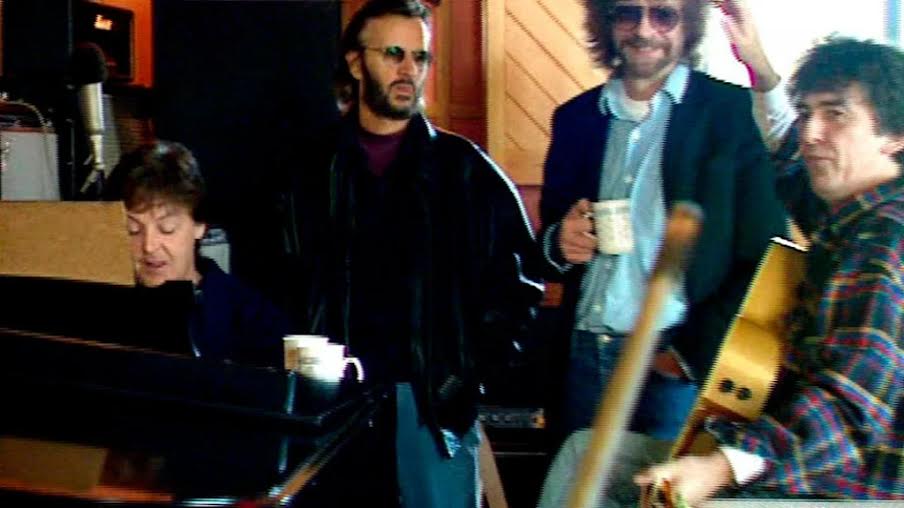
Second, the matter of a highly-skilled producer capable of bringing the necessary technical know-how to the table as well as an understanding of the Beatles’ sound was required. In this, George was particularly adamant about NOT using George Martin, who had been at work on the Anthology archival material. He was given the face-saving excuse of his ears not being up to the task, though he had already expressed privately his reservations about their going forward with the project at all. Jeff Lynne, George’s pal and Cloud Nine producer, was immediately offered up, over Paul’s initial concerns that their closeness would tip the balance of power (session discussion here: https://youtu.be/XqUiYg9hR90 ).
Ultimately, Lynne won Paul over (who then used him on Flaming Pie) but still, there were inter-band bumping of heads: Paul was adamant that their instrumental contributions remain Beatley, with no hint of any solo affectations. As soon as George whipped out his slide for the solo, Paul recalled rolling his eyes and going, “Oh god, here we go with ‘My Sweet Lord’!” But George’s contemporary-sounding stinging lead added the proper layer of grit and emotion without sounding anything at all like his previous solo work, giving the track resonance with record buyers steeped in grunge.
Adding solo vocals from Paul and George, as well as the Abbey Road-esque harmonies throughout, surrounding a fittingly ghostly Lennon lead vocal gave the song as good and fully-integrated sound as was possible, short of becoming their own tribute band. The results of their work made them ecstatic and emotional: “It sounds like the bloody Beatles!,” Ringo proclaimed.
The song peaked at 2 in the UK, 6 in the US, and won a Grammy for Best Pop Performance by a Duo or Group with Vocal. Fans over the years have, anecdotally at least, expressed a preference for the more upbeat “Real Love” that followed, but for the participants, THAT song – being more fully realized – made them feel more like session men and less like collaborators. The promo: https://www.youtube.com/watch?v=ODIvONHPqpk
Nowadays, with Peter Jackson’s team showing what AI can do with ghostly cassette vocals, the world awaits a proper retooling of “Free As A Bird” and “Real Love” along the lines of “Now And Then” for official issue. It’s not that hard: https://youtu.be/DJjUGXePCG4?si=k0wlSfihg-dJ4cf6
At The Mill, February 1994.