

Greetings all;
Let’s get the sad news out of the way first before moving on: first, the passing of EMI engineer John Kurlander. He began working with The Beatles while still in his teens; a class field trip when he was 13 saw him witness a bit of the Help! sessions, but he found employment there at 16 and it was when he was brought on board the Abbey Road sessions that he became a key player.
The Kurlander story concerns what happened inadvertently: he was on hand when The Beatles, or at least Paul, were listening to a playback of “The Long One” as the side two medley was called. As originally designed, the medley alternated between John and Paul songs. Following “Mean Mr. Mustard” was Paul’s “Her Majesty,” but upon hearing it fully realized, he declared that it didn’t work and asked Kurlander to excise it. It was Kurlander’s job to fulfill any Beatle’s wish, but he was also mindful of standing Parlophone rules (by 1969) not to discard anything the group recorded. Faced with this, he opted for what he saw as the best option: remove the song but splice it to the end of the master reel, following a suitable length of silence. This would be how the world came to hear the song, as a “hidden track.” (Those who believe it to be the world’s first apparently never listened to 1967’s Their Satanic Majesties Request, for starters.)
Kurlander went on to work on other Apple projects (Mary Hopkin’s Post Card and Badfinger’s No Dice), as well as with the four ex-Beatles. His greater achievements came with the soundtracks he worked on at the Abbey Road facilities in later years, including three Grammy wins for – ironically – Peter Jackson’s Lord of The Rings film trilogy. Here’s a terrific article on Kurlander’s work with The Beatles. He was 73.
Another sad farewell – for now at least – is to Erin Weber from the world of Beatling. When I first solicited feedback from you listeners for the 300th episode, asking for your favorite moments or conversations, hands down she came up at top of the list. It’s not hard to see why: her book, The Beatles and The Historians was a game-changer, showing us all how to read a book about the group, and how to judge them by the solid criteria employed by historians. Personally, I can’t look at history – any history – the same way again, and for that I thank her. I am happy that we had the opportunity to meet in person at The Fest a couple of years back, and look forward to the day when we cross paths again. But there is nothing more important than family and, for now, her energies must be directed elsewhere. But we owe her all a big thanks for what she’s given us and how it has impacted our enjoyment of Beatles history going forward.
Says Erin: “When McFarland published The Beatles and the Historians, I fully expected it to be little more than an obscure textbook for college history historical methods classes. (To be honest, I was trying to corner a small and uncompetitive academic market: there aren’t too many books on historical methodology and historiography, but history students still have to take those classes). I would have been fully happy in my little historian’s niche.
Instead, I was given the great opportunity to discuss the greatest band in music history with a number of amazing authors, fans, and musicians. I’ve attended conferences and had incredible discussions with some excellent podcasters, and made some fab friends, too.” Erin, if you never publish another word on The Beatles, your esteemed place in every SATB listener’s heart is indelible.
In good news: first, the recent Ringo shows in Nashville, taped for broadcast, have been announced as coming on March 10 – details here. Second: the amazing surprise Paul shows at Manhattan’s Bowery Ballroom – three in all. Here’s a write-up, but if anyone reading this was there, please contact me (subject line “Bowery”) if you’d like to serve as a stringer for the show. We’d love to hear your impressions. (Not sure how long this link will be working but here you go.) And then to follow it all up, Paul came on live as show closer for the Saturday Night Live 50 special on Sunday night. These are the things to savor while we can.
Does it seem odd when we are in the Ed Sullivan Show anniversary mode to consider that we are only 58 years out from the issue of the “Strawberry Fields Forever”/”Penny Lane” single? The lightning quick speed in which The Beatles evolved is staggering to consider in this day and age. Here, via the AdamBound channel, is a collection of all the footage shot for the SFF promo, directed by Peter Goldmann. He’d been recommended to the group by Klaus Voormann; given the staggering results of the collaboration, it is surprising that they never again worked with him. It was shot at Knole in Kent at Sevenoaks. Here is some background from folks who were there.
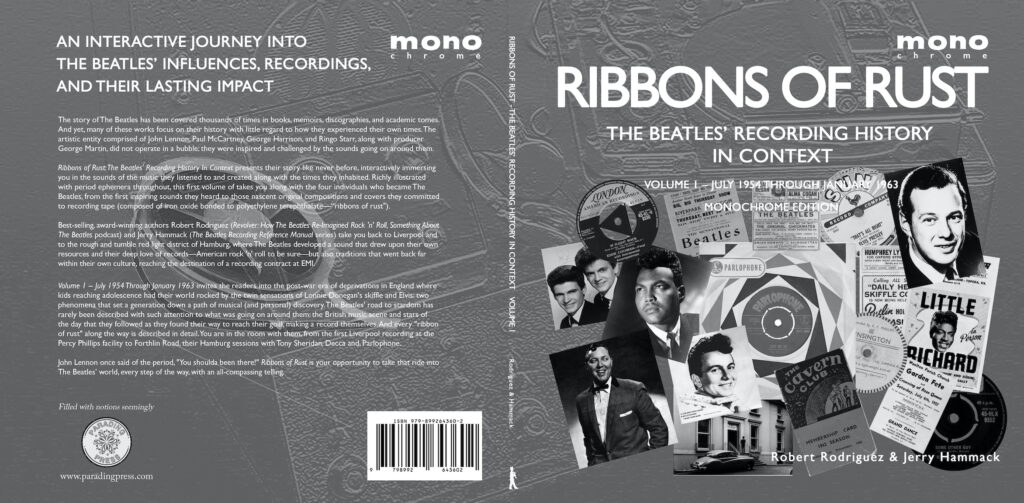
Last: here’s where the value of this Newsletter as a direct pipeline for your feedback has proven most helpful. Jerry Hammack and I knew in advance that using so much color in the new book, Ribbons of Rust, meant certain limitations: in addition to being a more costly printing process, Amazon – in certain Pacific markets (Australia and Japan specifically) – were not set up to produce a color print run. Personally, I am not so presumptuous to assume that surely there’d be a demand for this book absolutely everywhere, but hearing back from some of you was motivation enough to find a solution, and Jerry and I believe we have…
Essential in our thought process when putting this book together was placing the reader into The Beatles’ world as best we could. That meant the sights and the sounds, which we handled with the QR links throughout. Also, with period ephemera (something I’ve done with every one of my books), as well as the use of color throughout (which I’ve only done once before). The Beatles weren’t living in some pre-Oz land of black & white: they experienced the excitement of Hamburg and new record releases splashed with color, as well as films like The Girl Can’t Help It.
It is increasingly challenging in the 21st century, unless one makes the effort, to see the world through their eyes and not reflexively view it as a primitive, arcane period: the songs they covered were not oldies, they were the hits of the day. So color was key to the storytelling as we saw it.
But it was a deal-breaker technologically in markets beyond our reach. To that end, we’ve decided to publish a mono version of Ribbons of Rust (as in monochrome), available to all. It will be going live shortly.
And for those of you asking if an audio version would be made available, the answer is yes. Can’t say how soon we will have it produced, but it is in the works. Thanks for suggesting something we hadn’t anticipated would be needed.